
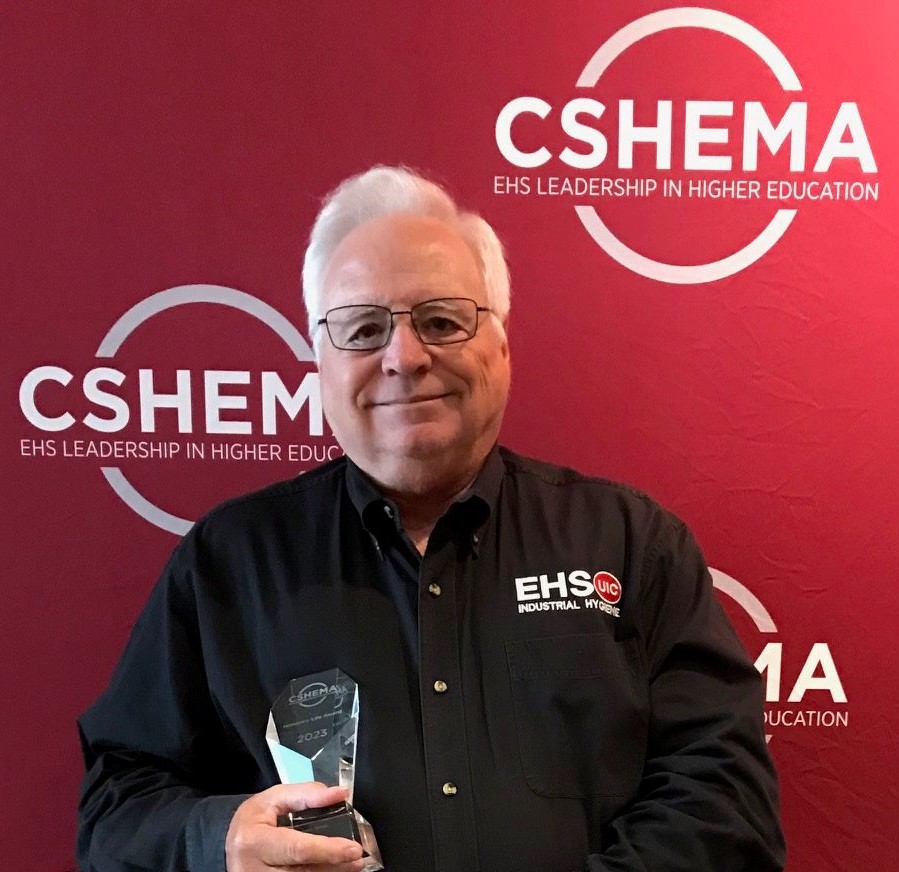
Dr. Terpin, Author, O.H.S.T., International Speaker, Certified Fire Officer, Paramedic is the Retired Senior Industrial Hygienist and Emergency Manager at The University of Illinois at Chicago (UIC), Dennis brings to this PDC over 55 years of laboratory and process safety experience. Dennis is a guest lecture at The University of Illinois Chicago School of Public Health, The University of Illinois Occupational Medical Residency Program. A presenter at AIHA 2025 PCS, ASSP and ASSP Safety Focus, National Safety Council, Board of Certified Safety Professionals (BCSP) Global Learning Summit BCSP, ACGIH Learning Pass, OH&S On-line, AGCIH webinars.
Identify new or existing hazards at public works, construction and process safety management required sites.
Evaluate PPE and respiratory protection based on site specific hazards.
Revisit site control, including exclusion (safe work zones)zones and decontamination areas.
The 8-hour HAZWOPER Operations and refresher training 29 CFR 1926.65(q)(8)) is designed for employees who have previously completed 24- or 40-hour training to maintain their competency. This program is customized for Public Works and Construction, DEMO, HAZWOPER, and disaster related activities. Students are encouraged to submit questions prior to the class. These questions will be incorporated into the course.
Public work and construction professionals are essential first responders, officially recognized since 2003 (PPD-8) (FEMA/DHS) for providing critical, 24/7 support during disasters, Emergency Support Function #3 (ESF 3). They operate under secure infrastructure, clear debris, and restore water, power, and roads to enable emergency services, acting as the "silent arm of public safety" by ensuring safe passage and rapid recovery.
Identify new or existing hazards at public works, construction and process safety management required sites.
Evaluate PPE and respiratory protection based on site specific hazards.
Revisit site control, including exclusion (safe work zones)zones and decontamination areas.
The 8-hour HAZWOPER Operations and refresher training 29 CFR 1926.65(q)(8)) is designed for employees who have previously completed 24- or 40-hour training to maintain their competency. This program is customized for Public Works and Construction, DEMO, HAZWOPER, and disaster related activities. Students are encouraged to submit questions prior to the class. These questions will be incorporated into the course.
Public work and construction professionals are essential first responders, officially recognized since 2003 (PPD-8) (FEMA/DHS) for providing critical, 24/7 support during disasters, Emergency Support Function #3 (ESF 3). They operate under secure infrastructure, clear debris, and restore water, power, and roads to enable emergency services, acting as the "silent arm of public safety" by ensuring safe passage and rapid recovery.
Identify new or existing hazards at public works, construction and process safety management required sites.
Evaluate PPE and respiratory protection based on site specific hazards.
Revisit site control, including exclusion (safe work zones)zones and decontamination areas.
The 8-hour HAZWOPER Operations and refresher training 29 CFR 1926.65(q)(8)) is designed for employees who have previously completed 24- or 40-hour training to maintain their competency. This program is customized for Public Works and Construction, DEMO, HAZWOPER, and disaster related activities. Students are encouraged to submit questions prior to the class. These questions will be incorporated into the course.
Public work and construction professionals are essential first responders, officially recognized since 2003 (PPD-8) (FEMA/DHS) for providing critical, 24/7 support during disasters, Emergency Support Function #3 (ESF 3). They operate under secure infrastructure, clear debris, and restore water, power, and roads to enable emergency services, acting as the "silent arm of public safety" by ensuring safe passage and rapid recovery.
Identify new or existing hazards at public works, construction and process safety management required sites.
Evaluate PPE and respiratory protection based on site specific hazards.
Revisit site control, including exclusion (safe work zones)zones and decontamination areas.
The 8-hour HAZWOPER Operations and refresher training 29 CFR 1926.65(q)(8)) is designed for employees who have previously completed 24- or 40-hour training to maintain their competency. This program is customized for Public Works and Construction, DEMO, HAZWOPER, and disaster related activities. Students are encouraged to submit questions prior to the class. These questions will be incorporated into the course.
Public work and construction professionals are essential first responders, officially recognized since 2003 (PPD-8) (FEMA/DHS) for providing critical, 24/7 support during disasters, Emergency Support Function #3 (ESF 3). They operate under secure infrastructure, clear debris, and restore water, power, and roads to enable emergency services, acting as the "silent arm of public safety" by ensuring safe passage and rapid recovery.
Describe the term Laboratory Process Safety?
Identify the parts of a laboratory operation?
Describe a laboratory process safeguard?
Explain what a Process Safety Standard Operating Procedure are?
This program is based Dr. Terpin’s article Protecting Research, Process Safety Concepts for Laboratory Operations published on August 2025 in AIHA publication, The Synergist ©. The understanding of Process Safety concepts for laboratory operations better prepares the laboratory staff to evaluate hazards associated within the operational phase of research projects. These operations can be broken down into four parts. All laboratory Activities (Tasks) or steps involved in the operation include, start-up, shut-down, phase change, testing of equipment, obtaining the necessary chemicals, heating, cooling, handling, weighing, mixing, order of addition and disposal of waste materials are just some of the activities involved in laboratory operations. Process Safety concepts help us evaluate the hazards and risks. This allows us to implement proper safeguards to mitigate risks.
SAFETY CONFERENCE
HEALTH CONFERENCE
ENVIRONMENTAL CONFERENCE
SAFETY CONFERENCE
HEALTH CONFERENCE
ENVIRONMENTAL CONFERENCE
Each year, the conference brings together 450-500 professionals from 29 states, 142 Illinois communities, and 3 countries, representing 465 companies across 26 industries all with a shared goal: advancing environmental stewardship, workplace safety, and public health
If you are, or
if you know of someone
who is an excellent presenter,
please consider our
2026 conference.